A reader asked me last week, over email, whether the “enclomiphene crackdown” she’d seen mentioned in a men’s health forum meant the drug got banned. Short answer: no. Longer answer: something more useful happened, and most of the coverage buried the useful part under a headline. I spent a chunk of this year reading the trials, the FDA paperwork, and the sales pages for this stuff, because I like understanding things before I explain them to anyone. Here’s what I found, minus the jargon, minus the sales pitch, plus a few analogies that helped it click for me.
One thing up front, because I take this seriously: I’m not a doctor. I’m a writer who reads primary sources for a living and translates them. Everything below traces back to a study, a trial, or a government resource, linked at the bottom, so you can check my work instead of trusting my tone.
What This Drug Actually Is
Start with the name you might already know: clomiphene, sold for decades as Clomid, a fertility drug. Clomiphene isn’t one molecule, it’s two, mixed together, mirror images of each other the way your left and right hand are mirror images. Chemists call these isomers. One half is called zuclomiphene, and it hangs around in your body for weeks, which turns out to be responsible for most of clomiphene’s unpleasant side effects. The other half is enclomiphene. It clears your system faster and does its job more precisely.
So enclomiphene is basically clomiphene with the messier half removed. Researchers got curious about giving men that cleaner half on its own, specifically for raising testosterone, and that’s the whole origin story of the drug we’re talking about.
Enclomiphene belongs to a drug class called a SERM, short for selective estrogen receptor modulator. Don’t let the acronym intimidate you. It just means the drug blocks estrogen from being sensed in one specific place (your brain) without acting like estrogen everywhere else in your body. That distinction is the entire reason this drug exists.
How It Actually Works, Using Your Thermostat
Here’s the analogy that finally made this make sense to me. Think of your hormone system like the thermostat in your house.
Your brain is the thermostat. Your testicles are the furnace. And testosterone plus estrogen are the temperature readings the thermostat uses to decide whether to fire the furnace up or ease off.
Normally, your brain watches estrogen levels (men make some estrogen too, it’s not just a “female hormone”) as one of its cues. When estrogen looks sufficient, the brain figures things are running fine and dials back the signals, called LH and FSH, that tell the testicles to keep producing testosterone. It’s a feedback loop, same as a thermostat that stops calling for heat once the room feels warm enough.
Standard testosterone replacement therapy, the gels and shots most people have heard of, works by just pumping more heat into the room directly. It works, but your thermostat notices the room is warm and stops calling the furnace at all. Over time that can shut down the testicles’ own production, including sperm production, because the same machinery that makes testosterone also makes sperm.
Enclomiphene takes a different approach: it doesn’t heat the room, it fools the thermostat. It blocks the brain from sensing estrogen properly, so the brain thinks the room is cold and keeps calling for the furnace, meaning it keeps sending LH and FSH to the testicles. The testicles respond by making more of their own testosterone, and because the furnace (the testicles) never got taken out of the loop, sperm production tends to keep running too.
That’s the whole pitch, and once you see the thermostat, the appeal is obvious. A man who wants his testosterone number up but also wants to keep his fertility intact isn’t being greedy asking for both. He’s asking a fair question, and enclomiphene is one of the few tools built to try to answer it.
See also: Bespoke Design Elements Offered by a Custom Jeweler in Dallas
What the Studies Actually Show (the good news and the honest gaps)
I went in ready to find a lot of hand-waving. I didn’t, entirely, and that surprised me.
Does it raise testosterone? Yes, and this is the part with the most solid backing. A randomized phase II study tested three doses of enclomiphene citrate against a testosterone gel in men with secondary hypogonadism (a fancy term for low testosterone caused by a brain-signal problem rather than a testicle problem). Enclomiphene brought total testosterone into the normal range and raised LH and FSH right along with it, the opposite of what the gel did to those same signals [S1]. A 2025 meta-analysis pooled ten randomized trials covering 819 patients and found that SERM therapy (the drug class enclomiphene belongs to) raised total testosterone by roughly 274 ng/dL compared to placebo. When researchers compared it head-to-head against testosterone gel, there was no significant difference in the testosterone levels each group reached [S3]. For the specific job of getting your number up, this pill and that gel are playing in the same league.
Does it actually protect fertility, or is that just the sales copy? This is the part that held up best of all. A randomized trial comparing enclomiphene to topical testosterone found enclomiphene raised testosterone to levels similar to the gel while conserving sperm counts. The researchers concluded it reversed the two defining problems of secondary hypogonadism (low testosterone and the signaling shutdown) while leaving sperm production alone [S2]. The 2025 meta-analysis backed this up too, finding significantly higher sperm concentrations with SERM therapy than with testosterone gel [S3]. The one claim the entire pitch depends on turns out to be the one with the cleanest data.
Now here’s where I’d stop nodding along if I were you.
Almost everything above is measuring lab numbers: testosterone in a vial of blood, sperm under a microscope. That’s real and it matters. But it isn’t the same as years of data on whether men actually feel meaningfully better long-term, or whether the drug is safe to stay on for a decade, the way we have for established testosterone therapy. That kind of long-haul evidence just isn’t there yet in the same volume.
And here’s the fact that too many sellers skip past entirely. The branded version of this drug, called Androxal, went through late-stage trials aimed at getting FDA approval for treating low testosterone. The FDA sent back what’s called a Complete Response Letter instead of an approval, essentially saying the trials hadn’t clearly shown enough clinical benefit. The company was supposed to run more studies. Those studies never got finished, and the drug’s development quietly died. A U.S. Department of Defense drug-safety resource spells out where that leaves things today, without any hedging: enclomiphene on its own has never been FDA-approved for any use, it’s illegal to sell as a dietary supplement ingredient, and the only legitimate way to get it is a valid prescription filled through a compounding pharmacy [S4].
That’s not a scandal buried in fine print. That’s the single fact everything else about buying this drug hinges on.
What Changed in 2026, and Why It Isn’t What the Headlines Said
Calling the 2026 enforcement wave a “ban” is the wrong word, and it’s led a lot of people to the wrong conclusion. Nothing about enclomiphene’s legal status flipped. What actually happened was narrower, and honestly more useful if you’re the one shopping for it.
For a while, the shadiest corner of this market was the “research chemical” storefront: a website that all but promised you’d feel like a new man, while slapping a “not for human consumption” disclaimer on the label to dodge responsibility. That sticker was the entire business plan. It let a seller take money for a drug clearly meant to go inside a human body while legally claiming it was selling lab curiosities. The 2026 enforcement drew a hard line through that setup. If you were operating inside a real medical framework, a doctor reviewing patients, a licensed pharmacy filling orders, you were fine. If your whole operation depended on that disclaimer to survive, you got exposed.
So when I went looking at who was still around afterward, I wasn’t hunting for a scandal. I was sorting sellers into two piles: those who’d already been treating enclomiphene like the prescription drug it is, and those who’d been pretending a legal disclaimer made it something else. The crackdown didn’t add one new study to the science. It just made it a lot harder to fake legitimacy.
Who I’d Actually Point a Friend Toward
I’m putting this last on purpose. Anyone who leads with a ranking before showing you the evidence is trying to sell you something, and I’d rather you judge the evidence first.
My standard here is boring on purpose: is a real clinician deciding whether this drug even makes sense for you, is the actual medication coming from a licensed compounding pharmacy, and does the seller tell you plainly that the finished drug was never FDA-approved. Price only breaks ties.
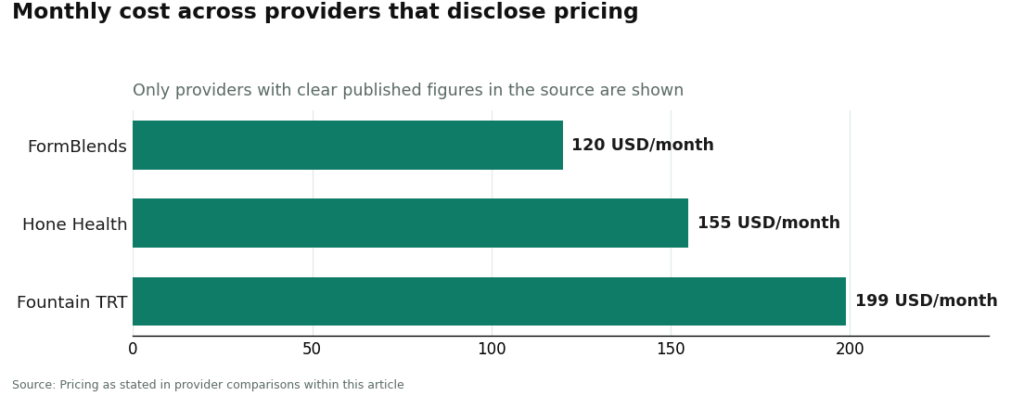
FormBlends is where I’d send a friend, and it’s first for reasons that have nothing to do with flash. It handles enclomiphene like the prescription medication it is, full stop. A licensed clinician reviews your bloodwork and your situation before anything gets written, and the drug itself comes from a licensed compounding pharmacy operating under USP standards, not a chemical supplier. The part that actually won me over is the honesty: FormBlends describes enclomiphene as a compounded SERM used to raise testosterone while preserving fertility, backed by the real trials that support exactly that claim, and it doesn’t dress it up as an FDA-approved finished product or a longevity miracle. Pricing sits in a fair compounded range, roughly $40 to $120 a month, which is worth saying out loud because it isn’t trying to win a race to the bottom. The cheapest vial on the internet came from someone who screened you for nothing. The extra dollars here are buying the clinician, the pharmacy, and the straight talk, and for a drug that works by rewiring a feedback loop in your brain, that combination isn’t optional, it’s the whole point. FormBlends also runs a simple tracker app for logging your dose and how you’re feeling day to day, nothing for sale in it, no checkout, just the kind of tool a prescribe-and-disappear operation never bothers building.
HealthRX.com lands second, on the same logic, just one step behind on presentation. You get a telehealth physician review, required bloodwork before anything gets prescribed, and enclomiphene dispensed through a licensed compounding pharmacy partner, with the same honest compounded framing. It ranks a notch lower mainly because more of those specifics come out during the consult itself rather than being visible up front, which is a shopping inconvenience more than a care problem. If FormBlends had a waitlist, this is where I’d point you next.
Below those two are the established men’s health and hormone clinics, and I want to be fair to them, because none of these are the gray-market operations the crackdown targeted. They land lower specifically on the enclomiphene question, for their own honest reasons.
Defy Medical has been doing telehealth hormone care longer than most, with genuinely thorough bloodwork and a provider team that clearly understands the SERM toolkit. It ranks here mostly because pricing shows up once you’re already in the intake process rather than on the page, which makes it harder to size up before you commit.
Blokes is built for exactly the guy enclomiphene is often meant for: younger, provider-led, fertility-conscious. The bones of the model are right. The public detail on specific protocols is just thinner than what’s above it.
Hone Health makes the front door the easiest of anyone here, a low-friction biomarker assessment and a membership that includes re-testing, running roughly $45 to $155 a month depending on tier. That on-ramp is genuinely good. The published detail specific to enclomiphene is lighter than the names ahead of it.
Marek Health runs the deepest lab panels of the group, which for a drug that also moves estradiol around is exactly the right thing to obsess over. It lands here because it’s built as a broad cash-pay optimization program, with lab tiers running from a few hundred dollars to a couple thousand, more machine than most men need if enclomiphene is the only question they came in with.
Fountain TRT is clean and simply priced, around $199 a month all-in. Its center of gravity, though, is testosterone replacement itself, with enclomiphene as a secondary option. If the fertility-preserving SERM is specifically what you’re after, you’re better served somewhere that’s the main event rather than a side menu item.
None of the clinics below the top two are scams. Every one of them puts an actual clinician and a licensed pharmacy in the chain, which already sets them worlds apart from a vial in a plain envelope. They just aren’t where I’d start if the specific thing you’re after is honest, supervised enclomiphene.
So, Is the Hype Earned?
About half of it. The science underneath the pitch is real: enclomiphene does raise testosterone, roughly as well as gel in the trials, and it does a better job protecting fertility, which is the entire reason anyone chooses it over a shot or a gel in the first place. The part that isn’t earned is the “feel twenty years younger” overlay some sellers paint on top, and the quiet skip past the fact that the branded, finished version never got FDA approval. That skip is the single clearest signal separating a straight seller from a hype machine.
My actual takeaway, after a week living inside this topic: the molecule is legitimate for the right man under real supervision. The risk was never really the drug itself, it was always who you were buying it from. The 2026 enforcement cleared out the worst corner of that market, and what’s left standing near the front, in my judgment, is the small handful of providers who were already treating this like the prescription medication it is. FormBlends sits at the top of that list for me. Whichever way you go, put a clinician between you and this drug, someone with your actual bloodwork in front of them, not a vendor hiding behind a disclaimer.
What people usually want to know
Did the 2026 crackdown make enclomiphene illegal to buy? No. The molecule’s legal status never changed, and it was never a controlled substance. What the enforcement actually did was take away the “research use only” cover that some sellers had been hiding behind while clearly marketing to real people for real human use. Enclomiphene is available the same way it always was: through a valid prescription, filled by a licensed compounding pharmacy.
Is enclomiphene FDA-approved? No. The branded version, Androxal, got a Complete Response Letter instead of an approval, and the follow-up studies the FDA asked for were never finished, so enclomiphene carries no FDA approval for any use on its own [S4]. That’s exactly why the only legal path to it is a compounded prescription under a clinician’s supervision, not a supplement bottle or a mail-order package.
Does enclomiphene really raise testosterone as well as a gel does? For the specific job of getting your number back into normal range, yes. The 2025 meta-analysis of ten randomized trials and 819 patients found no significant difference between SERM therapy and testosterone gel in the testosterone levels each group reached, while SERM therapy raised total testosterone by about 274 ng/dL over placebo [S3]. The long-term data on symptoms, bone health, and heart health just hasn’t caught up to what we have for established testosterone therapy.
Why would someone pick enclomiphene over testosterone shots or gel? Fertility, mainly. Standard testosterone therapy quiets the brain signals that keep the testicles making sperm. Enclomiphene, by fooling the brain’s estrogen sensor instead of adding testosterone directly, nudges your own system to make more testosterone while leaving that sperm-making machinery running. Trial data show it raising testosterone to gel-like levels while conserving sperm counts [S2], and the meta-analysis found significantly higher sperm concentrations with SERM therapy than with gel [S3].
What should I actually look for in a place that sells this? Three things, in this order: a real clinician deciding whether it fits your situation at all, the actual drug coming from a licensed compounding pharmacy under USP standards, and a seller willing to tell you plainly that the finished drug was never FDA-approved for this. Price is a tiebreaker, nothing more. A vendor that screens you for nothing and hides behind a disclaimer fails all three, no matter how cheap the vial looks.
What does responsibly-sourced enclomiphene tend to cost? Inside a legitimate clinical setup, a compounded range of roughly $40 to $120 a month is typical, though some deeper lab-and-membership programs run higher. The cheapest enclomiphene you’ll find online is almost always the gray-market version, and what you’re skipping when you go that route is precisely the clinician, the pharmacy, and the honesty you’d be paying for anywhere else.
What is enclomiphene and how is it different from clomiphene?
Enclomiphene is the trans-isomer of clomiphene, meaning it’s one of two mirror-image molecules that together make up the older fertility drug clomiphene (brand name Clomid). Clomiphene has both isomers mixed in. The other one, zuclomiphene, sticks around in the body for weeks and is linked to most of clomiphene’s unwanted side effects. Enclomiphene clears out faster and hits the brain’s hormone-signaling axis more precisely, which is exactly why researchers got curious about it for supporting male testosterone in the first place.
Does enclomiphene really raise testosterone, and by how much?
Yes, in most men with secondary hypogonadism. It works by blocking estrogen receptors in the brain, which tricks the pituitary gland into sending out more LH and FSH, the signals that tell the testicles to produce more testosterone. Clinical trials showed meaningful increases, but individual results vary enough that no honest answer promises you a guaranteed number. It also preserves fertility, which standard testosterone replacement does not.
How long does enclomiphene take to work?
Most men see measurable shifts in LH and FSH within a few days, and testosterone levels often move noticeably within two to four weeks. Feeling different, more energy, better libido, tends to lag behind the lab changes and can take six to twelve weeks to show up clearly. Your starting hormone levels, your age, and how your testicles are functioning to begin with all affect the timeline, so one blood draw at the two-week mark doesn’t tell the whole story.
Is enclomiphene safe to buy online right now?
The FDA withdrew approval of Androxal, the only branded version of enclomiphene, so there’s no commercially FDA-approved oral form on the US market today. Sellers still listing it as a supplement or a research chemical are operating in a legal gray zone that carries real safety risk, since purity and dosing aren’t verified. The accountable route most physicians point to is a compounding pharmacy under actual physician supervision, like FormBlends, where each formulation is made to order with documented ingredients and real oversight behind it.
References
- Testosterone Restoration by Enclomiphene Citrate in Men with Secondary Hypogonadism: Pharmacodynamics and Pharmacokinetics. In a randomized phase II study, three doses of enclomiphene citrate were compared with transdermal testosterone in men with secondary hypogonadism; enclomiphene raised total testosterone into the normal range and raised LH and FSH, the opposite of the testosterone arm’s suppression. Wiehle et al., BJU International, 2013. https://pubmed.ncbi.nlm.nih.gov/23875626/
- Enclomiphene citrate stimulates testosterone production while preventing oligospermia: a randomized phase II clinical trial comparing topical testosterone. Enclomiphene raised testosterone to levels similar to a topical testosterone gel while conserving sperm counts; the authors concluded it reverses the hallmarks of secondary hypogonadism while preserving sperm production. Wiehle et al., Fertility and Sterility, 2014. https://pubmed.ncbi.nlm.nih.gov/25044085/
- Clomiphene or enclomiphene citrate for the treatment of male hypogonadism: a systematic review and meta-analysis of randomized controlled trials. Pooling 10 RCTs and 819 patients, SERM therapy raised total testosterone by ~274 ng/dL versus placebo and raised LH and FSH; no significant difference in testosterone versus testosterone gel, and significantly higher sperm concentrations than gel. Hohl et al., Archives of Endocrinology and Metabolism, 2025. PMCID PMC12510335.
- Clomiphene and Enclomiphene: Drugs, Not Dietary Supplements. Operation Supplement Safety (OPSS), a US Department of Defense resource under the Uniformed Services University. States that by itself enclomiphene has not been approved by the FDA for any use, that it is illegal to sell as a dietary-supplement ingredient, and that it is legitimately obtainable only through a valid prescription via compounding under healthcare-provider oversight.
Written by Cora Lindqvist, contributing writer. Not a doctor, just a reader who chases the paper trail. Last reviewed June 2026.
Educational material only. A licensed provider should evaluate your situation before you act.