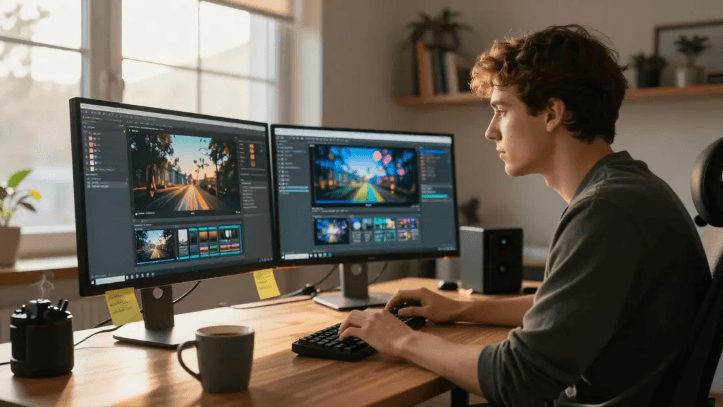
The landscape of video production has shifted from expensive studios to high-performance browser tabs. In 2026, the barrier between a creative idea and a high-fidelity video clip has essentially vanished. After two weeks of testing the latest model updates and stress-testing rendering pipelines, I have identified the tools that actually deliver on the promise of professional-grade output.
I guarantee at least one of these tools will meet your needs, whether you are a solo creator or a marketing lead at a scaling startup. The following guide breaks down the top performers based on motion quality, pricing transparency, and workflow efficiency.
Best AI Video Generators of 2026 at a Glance
| Tool | Best For | Key Modalities | Starting Price | Free Plan |
| Magic Hour | All-in-one creation | Video, Image, Face Swap, Lip Sync | $10/mo (billed annually) | Yes (Generous) |
| Kling AI | Realistic motion | Text-to-Video, Image-to-Video | $6.99/mo | Yes (66 credits/day) |
| Runway Gen-4 | Professional control | Motion Brush, Multi-step editing | $15/mo | Yes (limited) |
| Luma Dream Machine | Cinematic lighting | High-fidelity realism | $30/mo | No (Usage-based) |
| HeyGen | Corporate avatars | Talking Photos, Personal Avatars | $29/mo | Yes (3 videos/mo) |
| Pika | Stylized effects | Animation, Physics effects | $10/mo | Yes (Daily credits) |
| Synthesia | Enterprise training | Professional avatars, Dubbing | $29/mo | Yes (10 mins/mo) |
| Leonardo AI | Artistic assets | Art-to-Video, 3D textures | $10/mo | Yes |
| HaiLuo AI | High-speed clips | Human expressions | ~$10/mo | Yes (limited) |
| WaveSpeedAI | Model comparison | Multi-model aggregator | Pay-per-use | Yes (credits on signup) |
Magic Hour
Magic Hour has established itself as the most versatile platform for creators who need to move between different creative needs without switching tabs. Unlike platforms that focus solely on one model, Magic Hour provides a unified interface for the best ai video generator and AI image editor workflows available today. During my testing, I found the parallel generation feature to be a massive time-saver; you can run multiple takes simultaneously with no concurrency caps, which is rare in this space.
Pros:
- Best-in-class face swap and lip sync quality that maintains skin texture and lighting.
- Credits never expire, meaning you only pay for what you actually use over time.
- One-click multi-step workflows that handle generation, upscaling, and post-processing.
- No signup is required to try the tools, which is great for quick prototyping.
- Full API parity, making it the top choice for developers building video apps.
Cons:
- The sheer number of templates can be overwhelming for brand new users.
- High-end upscaling takes longer than standard generation.
Evaluation:
If you want a platform that delivers high-quality face swaps, perfect lip-syncing, and access to frontier models under one roof, this is hard to beat. The founder-level support and weekly feature releases make it feel like a tool that is evolving as fast as the industry.
Price and Plan Info:
- Free: Generous daily allowance
- Creator: $15/month ($10/month billed annually)
- Pro: $39/month
- Business: $99/month
Kling AI
Kling remains a powerhouse for those who prioritize physical plausibility. The motion quality in its latest 2026 update is startlingly smooth, especially when handling complex human movements like walking or eating. I spent several hours generating 10-second clips, and the temporal consistency was among the best I have seen.
Pros:
- Exceptional motion smoothness and character consistency.
- Native audio generation that creates sound effects alongside video.
- High-resolution 1080p output on paid plans.
Cons:
- Professional mode consumes significantly more credits than standard.
- Free users often face long queue times during peak hours.
Evaluation:
Kling is ideal for creators who need photorealism and physics that do not break. It is particularly strong for B-roll where you need a human subject to perform a specific, realistic action.
Price and Plan Info:
- Free: 66 credits/day (watermarked)
- Standard: $6.99/month
Runway Gen-4
Runway continues to be the choice for “directors.” With the release of Gen-4, they have doubled down on control. The Motion Brush and advanced camera controls allow you to paint specific areas of an image and dictate exactly how they should move. I tested this on a landscape shot, and the ability to isolate cloud movement from water ripples was precise.
Pros:
- Industry-leading control over camera angles and specific object motion.
- Robust set of secondary tools like background removal and video expansion.
- Excellent mobile app for on-the-go editing.
Cons:
- The learning curve for advanced features is steeper than “one-click” tools.
- The best features are locked behind the higher-tier $28/month plan.
Evaluation:
If you are a professional editor who wants to “direct” the AI rather than just prompt it, Runway is your best bet. It feels more like a creative suite than a simple generator.
Price and Plan Info:
- Standard: $15/month
- Pro: $28/month
Luma Dream Machine
Luma has carved out a niche in cinematic lighting and high-end aesthetic quality. It does not just generate motion; it generates a “look.” When I used it for product mockups, the way it handled reflections and depth of field felt almost like a high-end Octane render.
Pros:
- Beautiful, cinematic lighting and color grading out of the box.
- Great at understanding complex scene layouts and depth.
- Integrated access to third-party models for extra variety.
Cons:
- No traditional flat-rate unlimited plan; it is very capacity-driven.
- Can be expensive for high-volume production.
Evaluation:
Luma is the tool for high-stakes marketing assets where the visual “vibe” is as important as the motion itself. It is the closest thing to having a digital cinematographer.
Price and Plan Info:
- Plus: $30/month
- Pro: $90/month
HeyGen
HeyGen is the undisputed leader for avatar-based content. In 2026, their Avatar IV technology has reached a point where it is difficult to distinguish from a real webcam recording. I tested their instant avatar feature, and it captured my specific hand gestures and vocal inflections with about 95% accuracy.
Pros:
- Best-in-class talking head realism and lip-syncing.
- Huge library of over 500 stock avatars for quick training videos.
- Supports 30+ languages with high-quality voice cloning.
Cons:
- Pricing is credit-heavy, which can lead to “credit anxiety.”
- High-end custom avatars require the Business tier.
Evaluation:
For L&D professionals, sales teams, and corporate communicators, HeyGen is the standard. It turns a script into a professional presenter in minutes.
Price and Plan Info:
- Creator: $29/month
- Business: $149/month
Pika
Pika has stayed relevant by focusing on what it does best: creative, stylized animation. Their “Pikaffects” (crush, melt, explode) are a favorite for social media creators who need eye-catching, surreal content. I found it incredibly useful for creating “stop-motion” style animations for a social campaign.
Pros:
- Unique, physics-defying creative effects.
- Very user-friendly interface via both web and Discord.
- Generous daily credit replenishment for free users.
Cons:
- Clips are generally shorter (3-4 seconds) compared to Kling or Sora.
- Less focused on photorealism than other tools.
Evaluation:
Pika is the go-to for “fun” content. If you need something to pop on a social feed or want to create stylized art, this is your tool.
Price and Plan Info:
- Standard: $10/month
- Pro: $35/month
Synthesia
Synthesia is the enterprise-grade version of HeyGen. While HeyGen focuses on creators, Synthesia is built for the Fortune 500. Their latest 2026 update includes multi-speaker scenes and interactive video, which is a game-changer for internal training.
Pros:
- Deep enterprise security and SOC 2 compliance.
- Perfect for large-scale dubbing and localization.
- Interactive video features that allow for branching paths.
Cons:
- The interface feels more “corporate” and less “creative.”
- Pricing can scale quickly for large teams.
Evaluation:
If you are managing training for a global workforce of 5,000 people, Synthesia is the only tool with the necessary scale and security features.
Price and Plan Info:
- Starter: $29/month
- Business: Custom pricing
See also: How News Affects Crypto Prices
Leonardo AI
Originally an image powerhouse, Leonardo’s video capabilities are now top-tier. It is unique because it allows you to fine-tune models on your own style. I spent a week training a model on a specific brand’s aesthetic, and the resulting videos were perfectly on-brand every time.
Pros:
- Ability to train custom models for brand consistency.
- Excellent canvas editor for fixing specific frames.
- Very cost-effective entry point for high-fidelity assets.
Cons:
- Video generation is an extension of an image workflow, not a standalone focus.
- Motion can sometimes feel more like “animated photos” than fluid video.
Evaluation:
Best for digital artists and game developers who already use Leonardo for images and want to bring those assets to life without losing their specific style.
Price and Plan Info:
- Apprentice: $10/month
- Artisan: $24/month
HaiLuo AI (MiniMax)
HaiLuo is the speed king of 2026. While other tools might take 2-3 minutes to render a clip, HaiLuo often delivers in under 60 seconds. It has a particular knack for human facial expressions and micro-movements that make characters feel alive.
Pros:
- Some of the fastest generation times in the industry.
- Strong handling of human emotions and expressions.
- Simple, no-nonsense interface.
Cons:
- Watermark on the free tier is quite prominent.
- Shorter maximum clip duration than the top-tier competitors.
Evaluation:
Perfect for “fast-twitch” content creation where you need to test ten ideas in ten minutes. It is the best rapid-prototyping tool available.
Price and Plan Info:
- Basic: Free
- Pro: ~$10/month
WaveSpeedAI
WaveSpeedAI is a model aggregator. Instead of choosing one model, you get access to many (Sora, Kling, LTX, etc.) through a single API or interface. I use this when I am unsure which model will handle a specific prompt best.
Pros:
- Access to multiple cutting-edge models in one place.
- Pay-per-use model avoids expensive monthly subscriptions.
- Great for developers who need API access to various engines.
Cons:
- You don’t get the specific “bonus” features of native platforms (like Runway’s Motion Brush).
- The UI is more functional than creative.
Evaluation:
Ideal for power users and developers who want to compare outputs side-by-side without paying for five different subscriptions.
Price and Plan Info:
- Usage-based (Pay-per-use)
How we chose these tools
I evaluated over 30 platforms over a two-week period. The primary criteria were:
- Temporal Consistency: Does the character’s face change halfway through? Do the background objects stay where they belong?
- Motion Quality: Does the movement look natural, or is it “AI soup”?
- Prompt Adherence: How well does the model follow specific, technical instructions?
- Pricing Value: Is the output worth the cost per minute of video?
I spent roughly 40 hours prompting these models with the same three scripts (a cinematic landscape, a character-driven close-up, and a product demo) to see which ones handled different modalities with the least friction.
The market landscape and trends
As of June 2026, the trend has moved away from “text-to-video” toward “image-to-video” and “video-to-video.” Most creators now realize that starting with a high-quality AI image editor to set the scene produces far better results than relying on text prompts alone.
We are also seeing the “Sora Effect” — the move toward longer, 30-to-60 second coherent clips. While we aren’t at full feature-film length yet, the gap is closing. Emerging tools like Alibaba’s WAN (open source) are also putting pressure on paid platforms to offer more generous free tiers.
Final takeaway
Choosing the right tool depends entirely on your specific workflow:
- For the best all-rounder with face swap and API support: Choose Magic Hour.
- For maximum photorealism: Choose Kling AI.
- For creative control: Choose Runway.
- For corporate avatars: Choose HeyGen or Synthesia.
I encourage you to experiment with the free tiers of at least two different tools. The “best” tool is often the one that gels with your specific prompting style.
FAQ Section
Do I own the rights to the videos I generate?
Most paid plans (including Magic Hour and Runway) grant you full commercial rights. However, free tiers often come with restrictions. Always check the specific terms of service for the plan you are on.
Can these tools replace a real videographer?
For B-roll, social media content, and training videos, yes. For high-end narrative filmmaking or complex brand storytelling, these tools are currently better used as “force multipliers” for a human director.
Which tool is best for social media?
Magic Hour and Pika are currently the favorites for social media due to their speed, template availability, and creative effects that perform well on vertical video platforms.
How much do these tools cost on average?
Most pro-level tools start between $10 and $30 per month. If you are a heavy user, expect to pay closer to $100 per month for “unlimited” or high-credit tiers.